
How to Help Students Revise Their Work

Key Takeaways from Dysgraphia Life’s Webinar with Dr. Gary Troia
Revising writing is one of the most challenging—and most important—skills for students, especially those with dysgraphia or other learning differences. The latest Dysgraphia Life Expert Webinar, featuring special education professor Gary Troia, dives deep into the art and science of revision, offering actionable strategies for educators and parents.
Why Revision Matters—and Why It’s So Difficult
To start, Gary Troia reframed revision, citing authors who view it not as simple tweaking, but as “seeing and then re-seeing” one’s writing. Revision involves much more than correcting spelling or grammar—it’s about reflecting on ideas, goals, and effectiveness in communicating with an audience.
According to Dr. Troia, revising is particularly tough for novice or struggling writers. It demands metacognition (thinking about one’s own thinking) and self-regulation (strategically controlling thoughts and behaviors). Many students get stuck at the sentence or word level, missing big-picture issues like clarity or organization, and often feel overwhelmed by the sheer complexity of the task.
What Typically Happens in Classrooms?
Webinar poll results mirrored research findings: most teachers spend less than 30 minutes per week teaching revision. In fact, Dr. Troia shared that dedicated revision instruction is infrequent, and most feedback focuses only on mechanics (editing) rather than substance (meaningful revision).
Effective Teaching Strategies for Revision
The heart of the webinar focused on practical solutions. Here are some highlights:
1. Use Mentor Texts
Touchstone or mentor texts are short excerpts that clearly model desired writing traits. Teachers can color-code elements to illustrate genre features, vivid vocabulary, or effective dialogue—allowing students to compare strong and weak examples.
2. Try Flash Drafts
Instead of asking students to revise lengthy pieces, flash drafting involves writing in small, manageable chunks. This builds stamina, focuses attention, and reduces resistance to making changes.
3. Embrace Technology (But Be Strategic)
Word processors help with editing, but high-level revision requires more. Automated scoring and feedback platforms like Read&Write can support organizational aspects of writing, while peer conferencing remains invaluable.
4. Conferencing for Authentic Feedback
Teacher and peer conferences are essential for guiding students in revision. Teaching peer reviewers to offer praise, ask questions, and suggest “polish” (using the PQP routine) can help students see their work through readers’ eyes.
5. Goal-Setting and Self-Talk
Encourage students to set “SMART” goals—specific, measurable, attainable, realistic, time-bound—focusing on both process and content. Positive self-talk acts as an internal coach, keeping students motivated and focused during revision.
6. Checklists and Tactical Routines
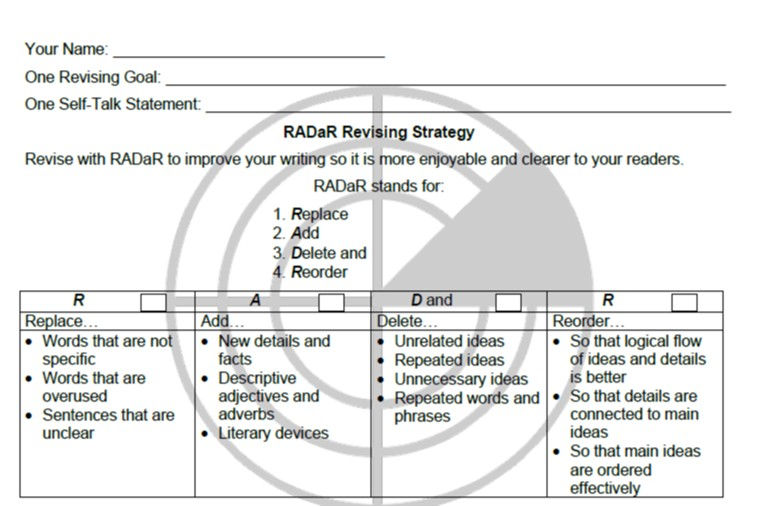
Customizable checklists help students remember what to look for, and tactical routines (like CDO—Compare, Diagnose, Operate; or RADAR—Replace, Add, Delete, Reorder) make step-by-step revision more systematic and less overwhelming.
Navigating AI and New Technologies
The webinar also tackled the emerging challenge of AI, like ChatGPT. While these tools offer possibilities for idea generation and basic editing, Gary Troia cautioned that students must critically evaluate AI-generated content for accuracy and relevance, and teachers should foster thoughtful integration rather than blanket use.
Final Thoughts
The webinar closed with a reminder: effective revision is a skill that can—and should—be explicitly taught. Utilizing short texts, authentic audiences, and targeted strategies can empower students of all abilities to become better writers.
For detailed slides, resources, and typing suggestions from the webinar, visit dysgraphiaLEARN. Watch the recorded session for deeper insights, and together, let’s help students transform their writing—one revision at a time.


This is such a helpful breakdown, especially the point about revising in stages rather than trying to fix everything at once. It's a principle that applies well beyond school-level writing too. As a law student, I've found the same approach useful when reworking essay drafts, tackling structure first, then arguments, then referencing, rather than trying to polish everything simultaneously. When a piece of coursework needs more support than a self-revision pass can offer, I've found Law Assignment Writing Service support genuinely useful for getting a second opinion on structure before a final submission. Revision strategies like the ones shared here are a great reminder that good writing is rarely right the first time, for any age group.
Thank you for this incredibly insightful webinar, Dr. Troia and Dysgraphia Life! I really appreciated the practical strategies like RADAR and using mentor texts—it's so helpful to have concrete, systematic tools to make revision feel less overwhelming for our students. The reminder to teach revision as "re-seeing" rather than just editing is a game-changer. Grateful for this valuable resource!
The webinar closed with a reminder: effective revision is a skill that can—and should—be explicitly taught. Utilizing short texts, Sprunki Retake, and targeted strategies can empower students of all abilities to become better writers.